

Last week Southern Living indulged my cranky inner uncle and let me publish my grievances against excessively cheffed-up barbecue side dishes, which posted on Saturday.
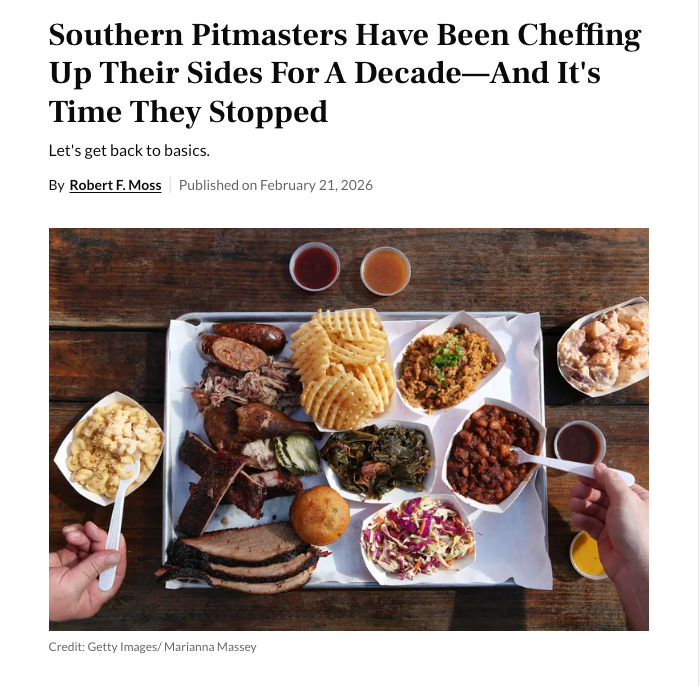
Much to my surprise, my editor didn’t even expunge the awful cheesy joke I snuck in toward the end of the piece. I thought for sure that one would end up on the cutting room floor.
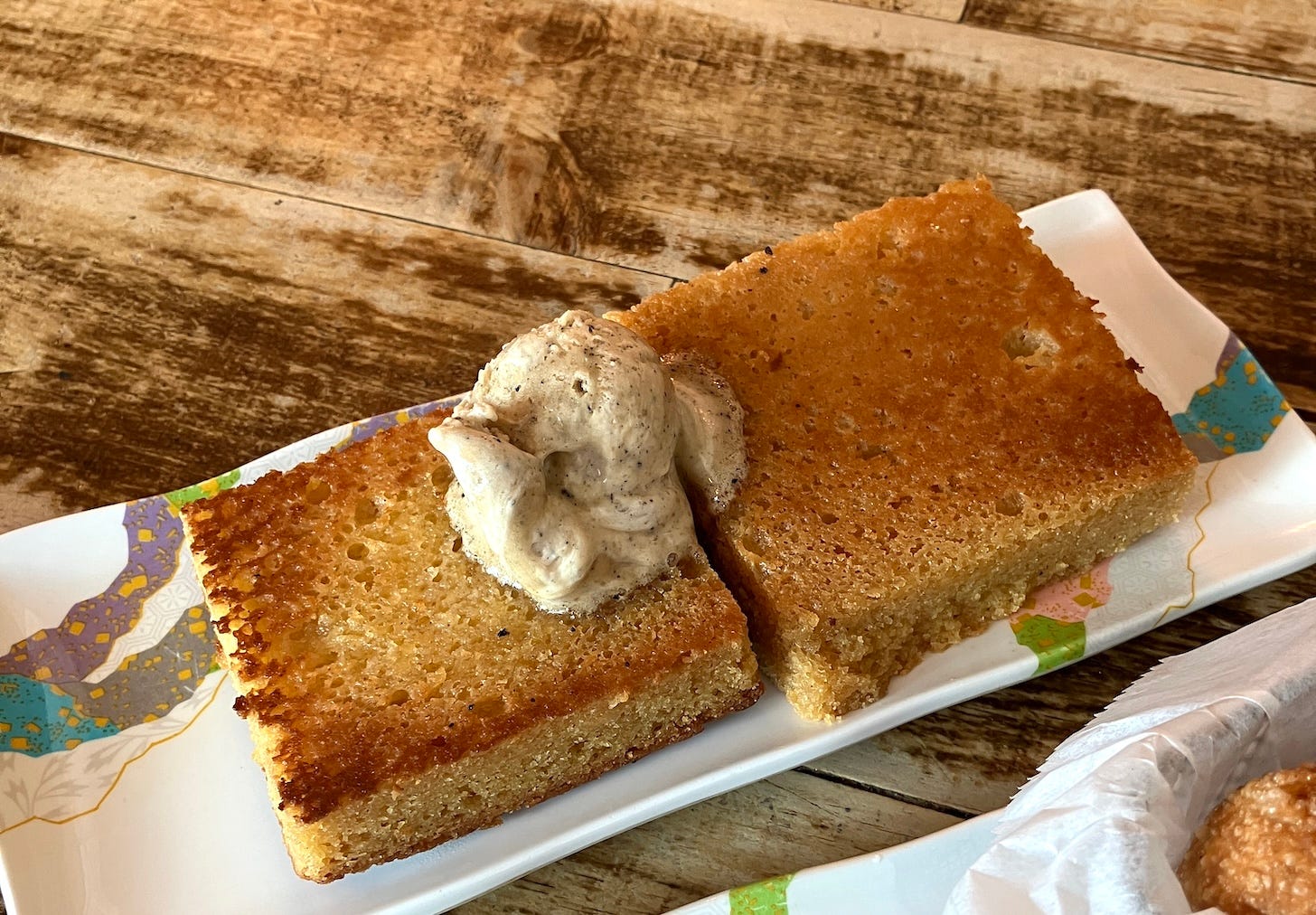
In truth, I was the one who did most of the cutting. One of the animadversions that didn’t make the final draft was my controversial take on cornbread, and not because I was worried about ruffling feathers. It just didn’t fit the theme, since the kind of cornbread I have beef with isn’t necessarily “cheffed-up” so much as “pastry cheffed-up” — which is to say made with a batter so loaded with sugar and finished with such sweet toppings that it should properly be called frosted corn cake.
Yes, I am one of those weirdos that likes their cornbread unsweetened. And by unsweetened, I don’t mean moderately sweet like a yeast roll or anything like that. I mean not a single grain of sugar in the batter. This puts me in the clear minority these days, but it wasn’t always the case.
The Great Corn Cakeification
In the last ten years we’ve witnessed a definite cake-ification of the cornbread in Southern barbecue joints. On my recent tours through South Florida and Texas, I encountered giant yellow slabs thick as paver blocks and as sweet as a pound cake. Many get even more sweetness from the stuff spread on top. For a long time cornbread was accompanied by a simple butter pat or a little cup of whipped butter. More recently, though, honey butter has become the standard, and some joints have taken it even further by blending in sorghum or maple syrup or dispensing with the butter altogether and drizzling raw honey over the top.
Another cake-ifying factor is the ratio of corn meal to wheat flour in the batter. Cornbread was originally just that — bread made with corn — but over the years, more and more wheat flour has been incorporated into the batter, which makes the crumb finer and mutes the richer corn flavor. Based upon a quick survey of published cornbread recipes from barbecue restaurant cookbooks, I would say the typical ratio is somewhere between 2:1 corn meal to flour to 1:1 — that is, equal parts.
The ratio in my personal cornbread recipe, I will note, is 1:0, for in addition to having no sugar, there’s not a speck of flour either. I got that recipe from my paternal grandmother, who in turn learned it from her mother. Plenty of otherwise sensible Southerners (my wife, for instance) had grandmothers who adulterated their cornbread with flour and sugar, so they grew up accustomed to the flavor. There’s a perfectly reasonable explanation for why some of those grandmothers turned to sugar, and it has to do with the changing nature of cornmeal during the 20th century.
A Historical Detour
In the beginning, there was cornpone. This progenitor of all modern cornbread was made from a basic batter of cornmeal mixed with water and a little salt. It was typically cooked in a greased iron skillet or Dutch oven placed directly on the hot coals in a fireplace, with an iron lid placed on top and covered with another layer of embers on top to effectively bake it within the pan.
Over time, the basic pone recipe was enhanced, first with buttermilk and a little baking soda, which helped it rise. Later, eggs and baking powder entered the mix, making a richer blend. Two ingredients you almost never find in any recipe before the 20th century are wheat flour and sugar.
A New York Times article in 1892 surveyed the many types of corn-based breads eaten in Virginia and observed that “in none of them is sugar used. There are cornmeal puddings served with sweet sauces, but no Southern cook would risk the spoiling of her cornbreads by sweetening them.” [emphasis mine] In 1937, the Times reported that in Kentucky cornbread “is made with white, coarsely ground cornmeal. Never, never are sugar and wheat flour used in cornbread.” [again, emphasis mine]
So why were cooks so unanimous on the subject of sugar and flour back then but so divided on it today? The 1937 Times story pointed at the answer when it noted, “Water-ground cornmeal and water-ground whole wheat flour have still a market in Kentucky and are still used with delight.” That wasn’t the case in most other places. A major shift was underway in the cornmeal market.
In the 19th century, most farm families obtained cornmeal via toll milling. They would take the corn they grew themselves to a nearby mill to be ground, leaving behind a portion as a “toll” to pay the miller. The mills were typically water-powered and ground the corn between pairs of flat circular millstones, which crushed the dried kernels into a coarse-grained powder.
Around 1900, however, new “roller mills” were introduced that pulverized the kernels between cylindrical steel rollers. As large milling companies set up roller operations in Southern towns and cities, they increasingly squeezed the older stone mills out of the market. Unlike grindstones, steel rollers stripped away much of the corn kernel, including the germ and the oils. The resulting meal was more shelf stable, but it was also stripped of much of its flavor and nutrition.
At the old stone mills, the ground corn would be shaken through a large screen, with the part falling through the screen being bagged as cornmeal and what was left on top used as grits. That stone-ground meal had a much more diverse particle size than the roller mill product, and therefore a fuller texture when baked into bread. It also had a lot more sweetness than the meal from high-volume mills, which increasingly used corn harvested unripe and dried with forced air before natural sugars could fully develop. The new cornmeal tended to be yellow, too, instead of white, as the mills turned to newer commodity varieties.
As cornmeal’s character changed, cooks found they needed to adjust their cornbread recipes. The finer cornmeal particles didn’t react as vigorously to chemical leavening like baking soda, so bakers started adding a little wheat flour to get the desired crumb. Since industrial cornmeal lacked the natural corn sweetness of stone-ground meal, they started incorporating a teaspoon or two of sugar, too.
By the end of the Depression, stone-ground cornmeal had all but disappeared from the South, replaced by bags of finely-ground yellow powder. (Stone-ground grits had all but disappeared, too — another story of sad decline.)
Veteran cooks knew there was a difference, though. “A very different product from the yellow cornmeal of the North is this white water-ground meal of the South,” Dorothy Robinson wrote in the Richmond Times Dispatch in 1952.
The two are not interchangeable in recipes. Most standard cookbooks, with the exception of a comparative few devoted to Southern cooking, have concerned themselves with yellow cornmeal recipes as if they did not know any other kind! They do not even distinguish between the two. They simply say, naively, ‘a cup of cornmeal’ when listing ingredients in a recipe.
Even cooks in the know were finding it hard to get their hands on the old stone-ground stuff. In 1950, Mrs. Francine J. Parr of Houma, Louisiana, sent a desperate query to the New Orleans Times-Picayune asking, “Who’s got coarse grits?” She explained, “the only grits we can get is very fine and no better than mush. In short, I’m advertising for some grocer or other individual selling coarse grits to drop me a line.”
The Divergence
So that’s how the sweetening started, but it doesn’t quite explain the sharp divergence we are seeing here in the 21st century. It’s one thing to add a spoonful of sugar to replace the sweetness gone missing from the corn; it’s another to dump in a quarter cup or more, as I routinely see in contemporary recipes, much less load it up with toppings resembling whipped frosting.
A few traditionally-minded barbecue cooks are bucking the corn cake trend. Perhaps most notable among them is Sam Jones, who at his two Sam Jones BBQ restaurants in Winterville and Raleigh is sticking to the family recipe from Skylight Inn and baking his cornbread in lard-greased metal pans with a simple batter of cornmeal, salt, and water.
And, boy, has that fundamentalist cornbread brought out the haters, especially in hoity-toity Raleigh. Online commenters have likened it to hardtack, roofing shingles, door stops, and hockey pucks and asserted it “had no taste whatsoever.” Jones ended up adding sweet potato muffins to the menu for those who prefer pastries with their barbecue, and he’s even launched social media video campaigns to try to make light of the situation.
“It’s probably one of the more contentious items on the menu,” he admits in one video, but he’s adamant that “it’s never leaving.”
Interestingly, the recipe published in Jones’s Whole Hog Barbecue (2019) reveals that the cornmeal is actually augmented with a small amount of Moss Light n’ Sweet Hushpuppy Mix with Onions, so it does get a trace of sugar and leavening, though with just 2-1/2 tablespoons of mix to 3 cups of white cornmeal, it’s pretty darn scant. A 2024 News & Observer story on the cornbread controversy adds another intriguing detail:
For many years, Skylight sourced its cornmeal from a Lenoir County mill that dates back to the Civil War and possibly the Revolutionary War, until the mill was shut down after Hurricane Floyd in 1999.
I have to wonder if that’s when they started adding the touch of hushpuppy mix. (And, no, I have connection to the Moss Hushpuppy Mix brand.)
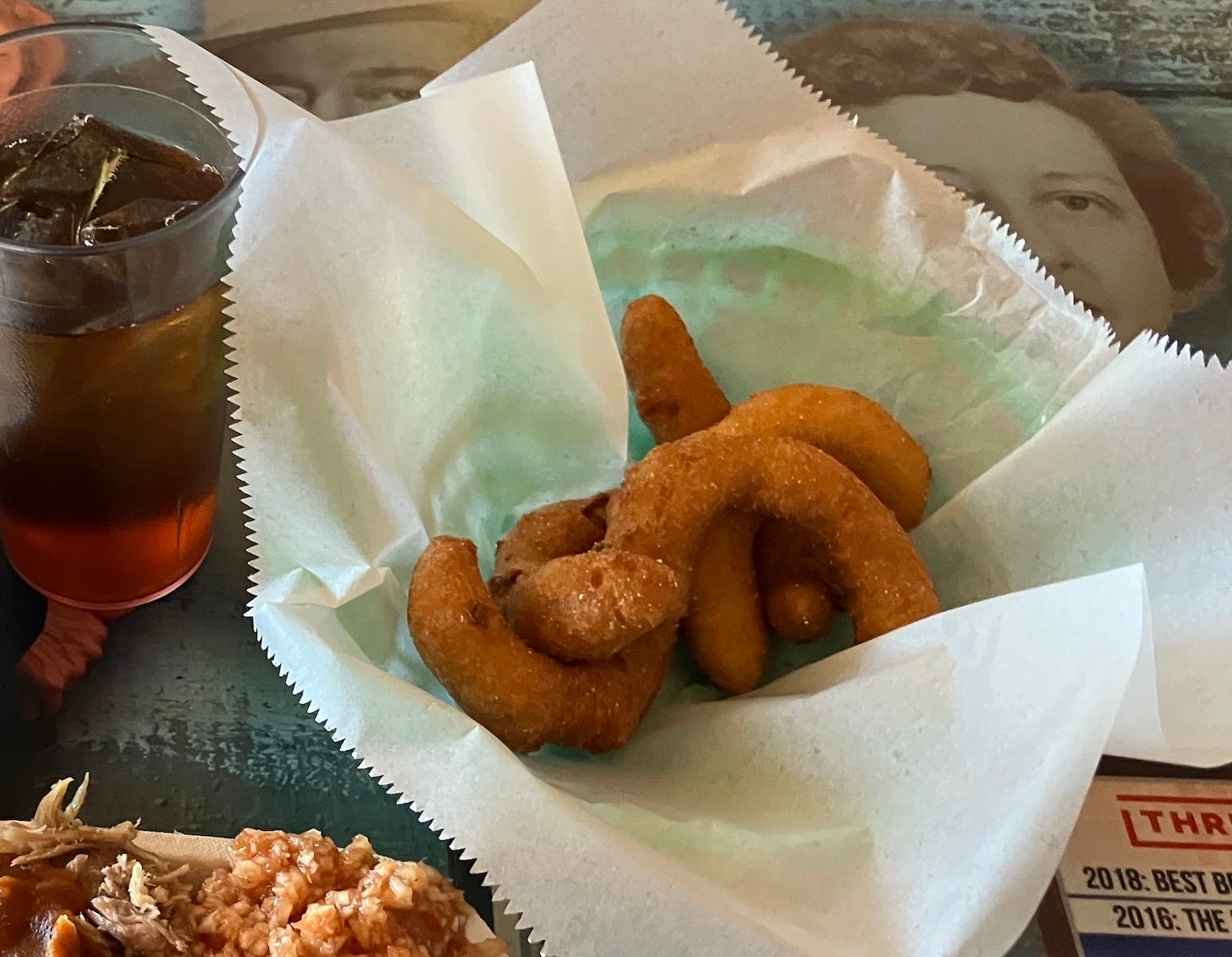
While we’re on the topic, I will point out that a hushpuppy (or red horse bread, as it’s more properly called) is just cornbread dropped in a deep fryer instead of cooked in a skillet. Most of the ones I encountered on my recent Piedmont North Carolina barbecue swing, like the splendid curled variety at Red Bridges Barbecue Lodge in Shelby, are not noticeably sweet at all.
Like Sam Jones, I’m not giving in to the vagaries of fashion and starting to put sugar in my cornbread. I am, however, aspiring to mellow a bit in 2026 and be more open minded when it comes to accepting non-traditional barbecue variations. (Drawing the line at brisket, of course.) I will even admit that I have enjoyed some of the sweetened cornbread I’ve encountered at newer barbecue joints recently.
The version at Apocalypse BBQ in Miami, for instance, has a mildly sweet crumb and is finished with a big drizzle of honey and flakes of sea salt. It’s also baked in little skull molds, which is 100% on brand for a joint named Apocalypse, and useful for frightening small children, too.
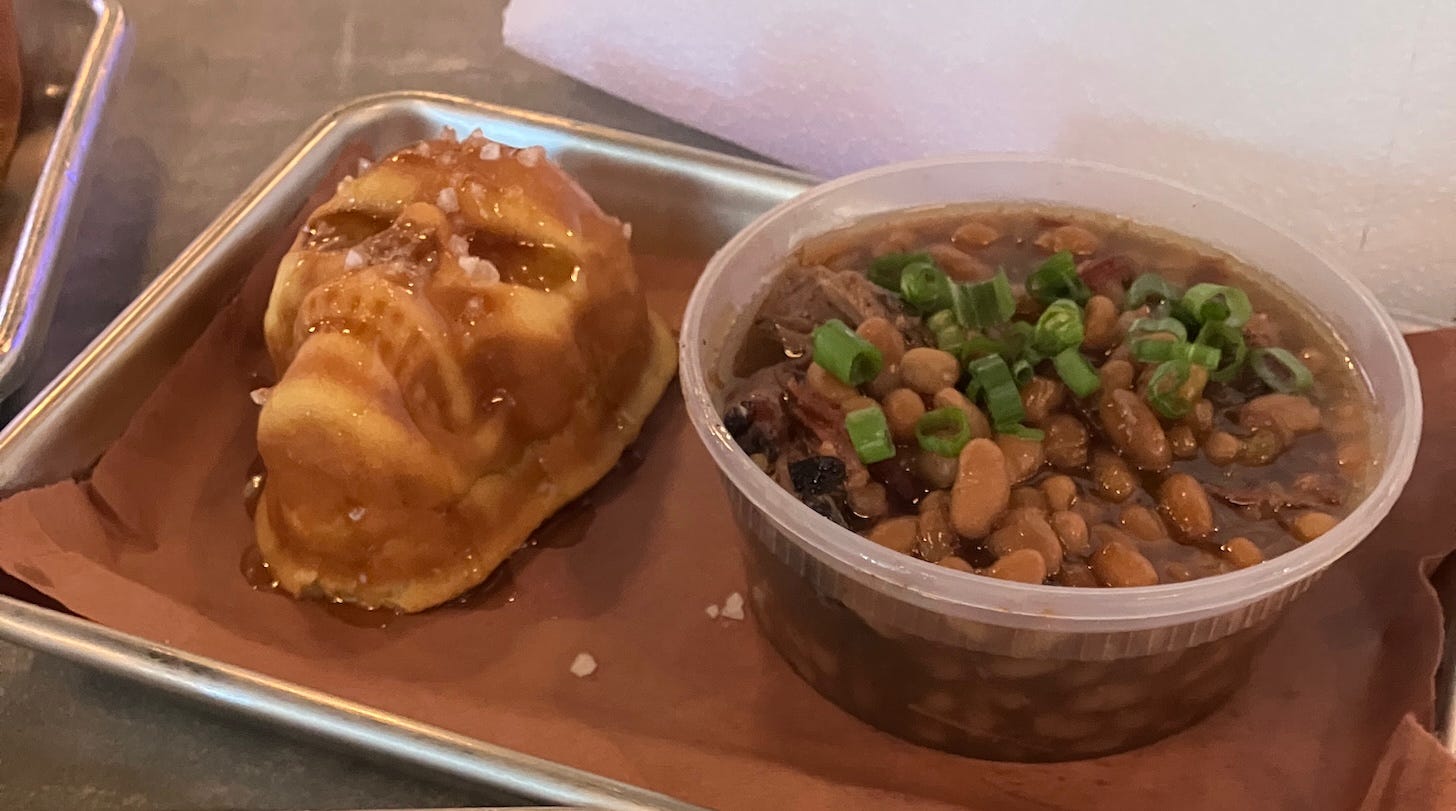
I did, however, eat the ribs and beans first and the save the cornbread for the end. It was a pretty tasty dessert.
Vox Populi
Quick Hits
Mike Jordan profiles pitmaster Bryan Furman for the Atlanta Journal-Constitution and explains how Georgia’s “King of BBQ” ended up in Portland, Oregon, for a three-month barbecue residency.
The Macon Telegraph reports that one of the oldest barbecue joints in Georgia is making moves. Fincher’s Barbecue, whose original Macon location opened in 1935, is preparing to open a fifth restaurant up the road in Warner Robbins. It will join an existing Fincher’s location already in Warner Robbins and two more in Macon.
Longleaf Swine opened its first location in downtown Raleigh in 2023 and already has a second in the works in North Raleigh. This week Drew Jackson of the Raleigh News & Observer got the scoop that the owners are now planning a third location to be opened in what they call “a barbecue desert.” No, not Ohio. The restaurant is taking over the space in nearby Carrboro currently occupied by Luna Rotisserie & Taproom. In a divergence from its Raleigh menu, the Carrboro outpost will offer vegan and vegetarian options — to ease those desert-dwellers into the whole meat-eating thing, I guess.
Burnt Ends
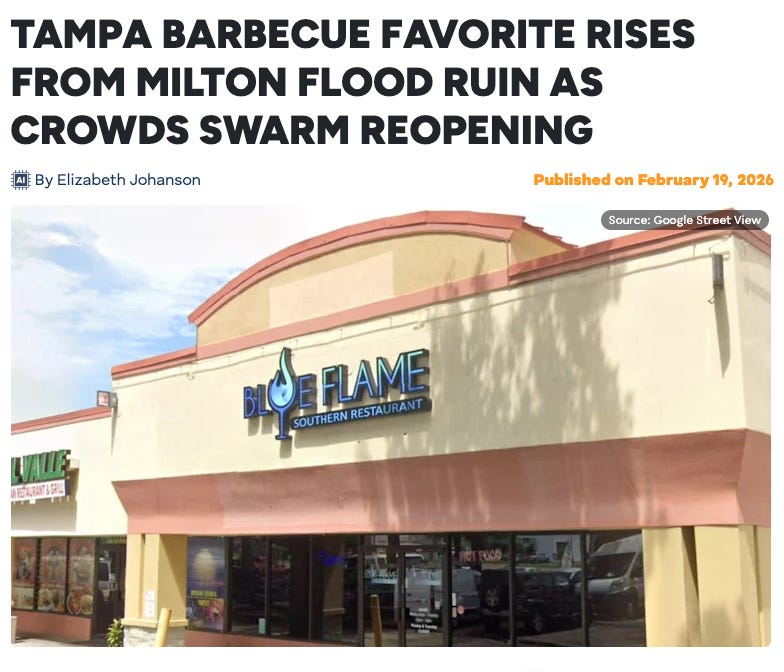
Hoodline Headline of the Week
There is a lot going on in this headline from the Hoodline Tampa web site.
Payback is Hell
Adam Davidson of the Houston Chronicle reports that Texas-style barbecue restaurants are taking South Korea by storm. He interviews entrepreneur Jay Lee, who has opened a brisket joint named Tehas in Wonju, a city of 365,000 in Gangwon Province. Lee reportedly “has big plans to expand Tehas and spread the word of authentic Texas ‘cue across Korea.”
I say it’s only fair. They inflicted K-Pop on us first.
No sugar unless it’s Corn Pudding. Parker’s in Eastern NC made the best Corn Sticks ever! I bought the cast iron pans to cook them in, but have yet been able to make one close to Parker’s. I believe I read one time that they were baked and then deep fried. They were to die for. Thx
This is the kind of food writing that I enjoy - how people used to cook in the not-too-distant past. I was surprised to learn that my late grandmother’s (b. 1905) cornbread recipe was one favoring a more recent style.