


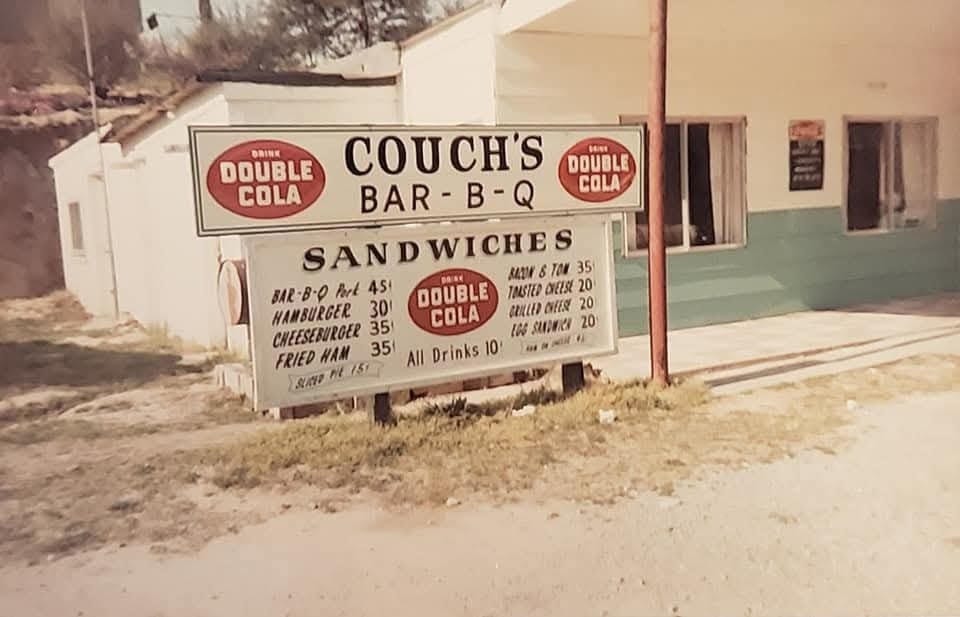
Steve Ray of the Owls Nest BBQ Show passed along some historic pictures from Kenny Stiner of Couch’s Barbecue in Ooltewah, Tennessee, including the one above showing the old curbside menu board. Couch’s opened in 1946, and based upon the cars in some of the other photos, I would judge these were taken in the late 1950s or early 1960s.
The prices stand out, of course, especially here in our current era of $40-a-pound brisket. The rather modest nature of the offering, with grilled cheese and egg sandwiches alongside the barbecue ones, underscores how much barbecue restaurants have changed since the era when they were essentially quick-service sandwich shops. More than anything, though, it got me thinking about robots.
Bear with me on the robots part.
Paring It Down
Here’s a picture of a different Couch’s menu board, which, judging by the slightly lower prices, is from a few years earlier.
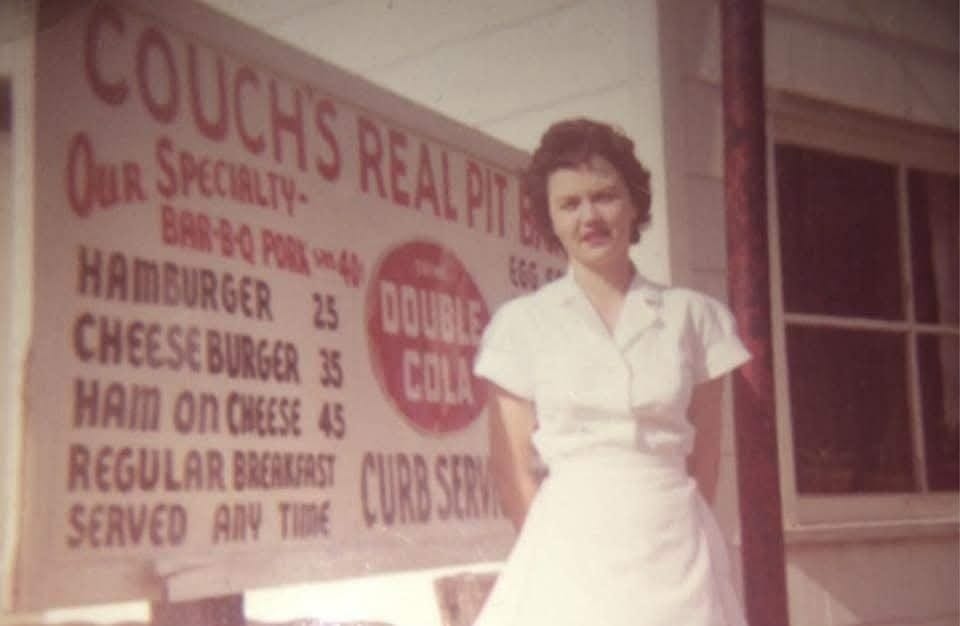
As the menus show, a barbecue sandwich back then was a premium item, selling for at least 50% more than a hamburger. In the post-World War II years, though, it became harder and harder for restaurateurs to turn a profit on barbecue. The wood-fired pits became increasingly expensive to operate, in part because of the rising cost of wood. Labor was a big factor, too, since barbecue not only took a lot longer to cook than a burger but also wasn’t something you could hire a kid off the street to do with just a few hours of training.
The result was a divergence in the market. Some stuck to wood-fired pits and leaned into the barbecue, like the Skylight Inn in Ayden, North Carolina, whose distinctive octagonal building is a legacy its drive-in origins. When Pete Jones opened Skylight in 1947, the menu included hamburgers and hot dogs alongside the barbecue, but he eventually dropped those to focus on whole hog.
Many others took the fast food route and ditched the expensive pits to focus on burgers and other quick-service items. Perhaps the most notable example is the restaurant founded by Richard and Maurice McDonald. I tell the full story in my book Barbecue: The History of an American Institution, but in the late 1940s the brothers temporarily shuttered their struggling San Bernardino drive-in for an overhaul.
Their original menu featured beef, ham, and pork cooked on a hickory-fired pit, but when they reopened, the barbecue was gone, as were the carhops and the china and silverware, too. The pared-down menu offered just hamburgers and cheeseburgers made with thin 1.6-ounce patties accompanied by french fries, coffee, milkshakes, and soda. The prices were slimmed down as well, with the hamburgers dropping from their original 35 cents to just 15. Now there are more than 13,500 McDonald’s restaurants the U.S. and more than 44,000 worldwide.
The McDonalds’ Speedy Service System was the most successful of the many attempts by entrepreneurs to streamline restaurant operations during that era, but as Michael Karl Witzel documents in his book The American Drive-In, there were plenty of other less-successful efforts. The Motormat, for instance.
This unique innovation was the brainchild of Kenneth C. Purdy and debuted in Los Angeles in 1949. Motormat diners parked their cars in stalls around the giant wheel-like layout, where they would order and be served via a track-mounted stainless steel carriage. Customers would write their order on a pad, place it on the carriage, and press a button to send it gliding into the central building. There, an attendant would tally up the bill and send it back to the motorist to be paid. Once the food was ready, it would be rolled out to the customer, no roller-skating carhop required.
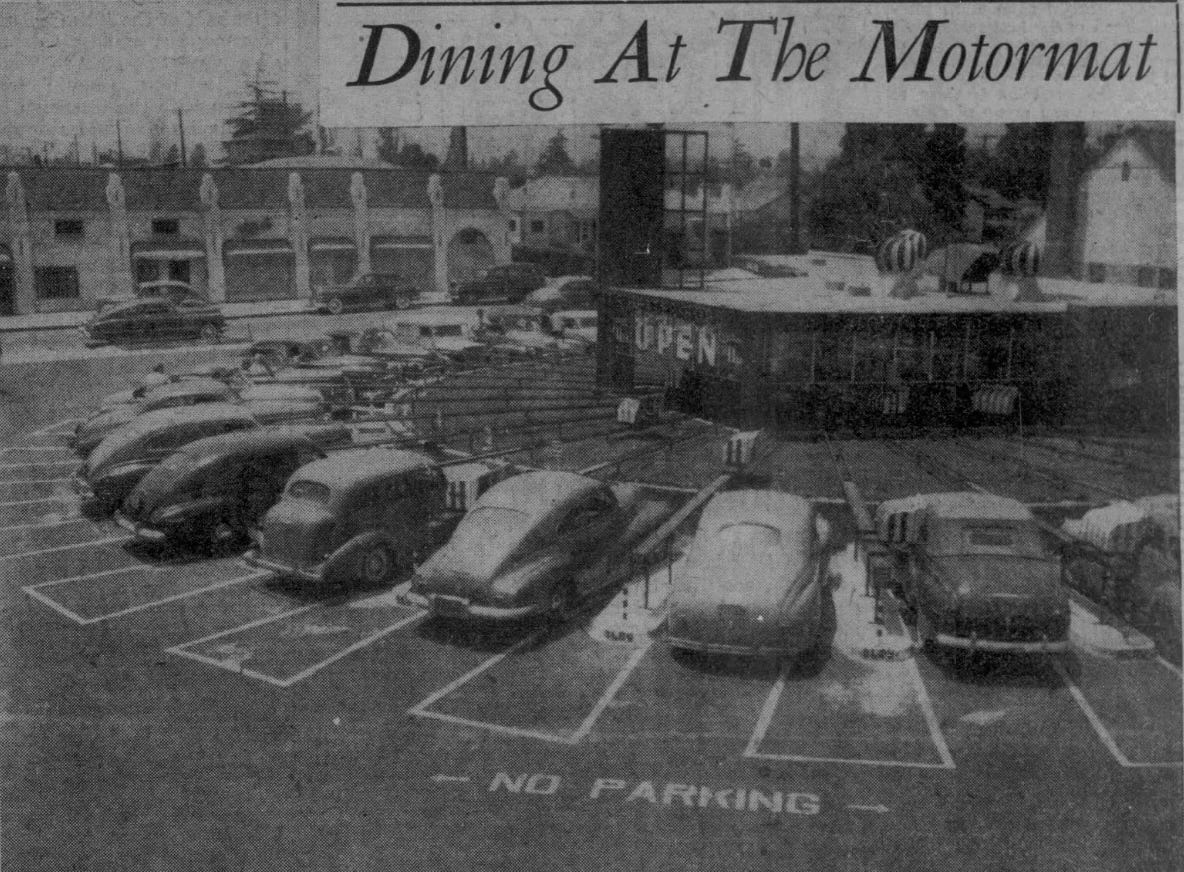
Purdy boasted his 20-stall system could serve 960 cars in a 16 hour day and required only a fraction of the former staff. It cut the time it took a customer to eat a meal by 30 to 50 percent and eliminated tipping. It apparently reduced sexual harassment by a good 30 to 50 percent, too. “Cute carhops in tight slacks are on their way out, fellas,” began the Universal Press syndicate’s write-up. "If a man wants to ogle a pretty Miss in a skin-tight costume, he can patronize the old-fashioned drive-in.”
The Motormat opened a second Los Angeles location in June 1950 and its first Florida restaurant in Miami in July. By the end of the year, Purdy was telling newspapers he had 116 locations throughout the U.S., but I am dubious of that figure, since the Los Angeles and Miami restaurants are the only ones I can find evidence of.
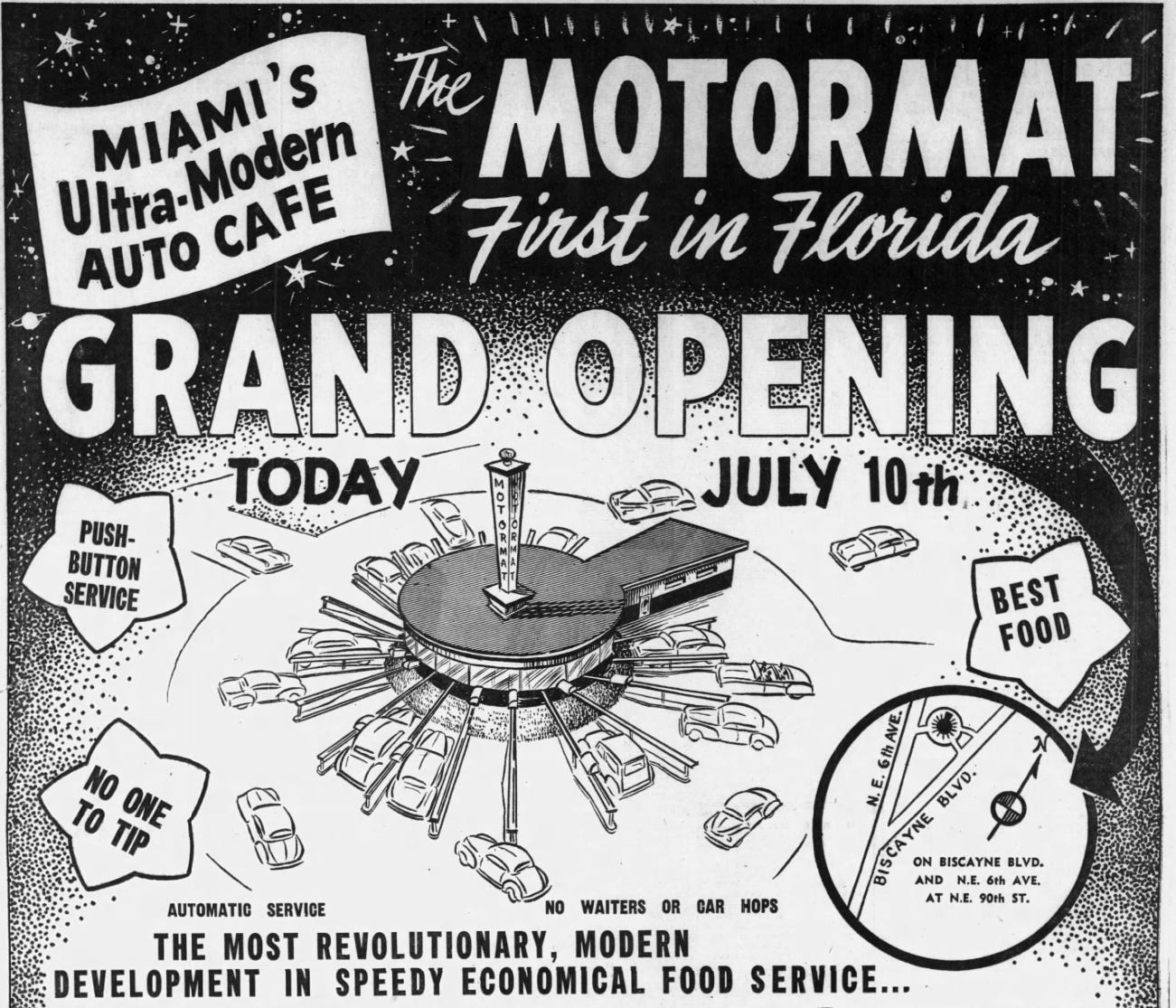
The Miami Motormat was defunct by within a year, and its space was taken over after “extensive alterations” by a restaurant called the Pickin’ Chicken, which featured fried chicken along with—can you guess?—barbecued chicken and ribs. Perhaps the Motormat’s complicated conveyor belt system was too prone to breakage, or maybe customers just missed ogling the carhops, but I can find no trace of the “ultra-modern auto cafe” after 1951.
Not every old-school joint made the Sophie’s choice between burgers and barbecue. Couch’s still serves cheeseburgers, BLTs, and grilled cheese sandwiches just like they did back in the 1950s. Here in Charleston, Bessinger’s BBQ and Melvin’s BBQ started out as full-service drive-ins back in the 1960s, complete with carhops. Though the curb service is long gone, both still make some of my favorite burgers in town—the old-school, not-too-thick, nicely-toasted bun and well-melted cheese variety.
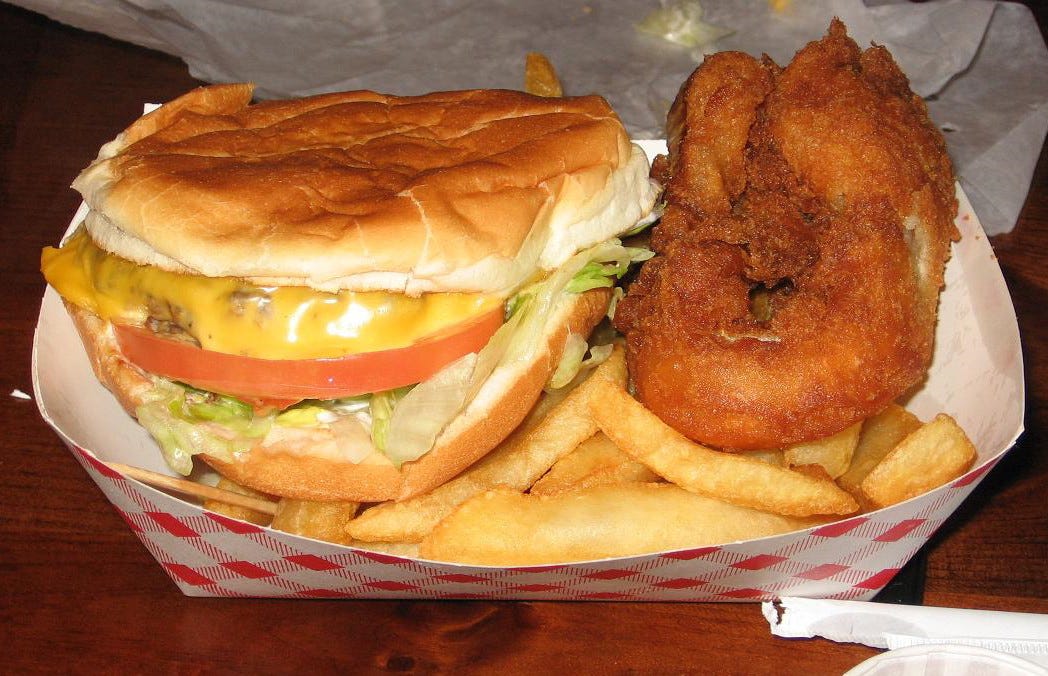
And, yes, as Michael Bessinger will happily bend your ear about if you ask, the high cost of labor remains a challenge to this day.
I Will Replace You With Machines (Someday)
That brings us to the robots, finally. In November 2021, I ran a Cue Sheet dispatch entitled, “The Restaurant Robot Revolution Is Finally Just Around the Corner . . . And We Really Mean It This Time.” It was about Flippy, the burger-flipping robot from start-up Miso Robotics, which, if you believed the press at the time, was about to revolutionize the restaurant industry. Writing about restaurant automation got me wondering what Flippy is up to these days.
Long-time readers will recall I was dismissive of the breathless claims of a pending restaurant revolution, which in 2021 were presented in the context of the then-acute staffing challenges facing restaurants and ghost kitchens (remember ghost kitchens?) A flurry of news stories (like this one from CNBC) asserted that restaurants were navigating the “long-term labor crunch” by “turning to robots.”
By the end of 2021, Miso had already moved Flippy from the griddle to the fry station, since it apparently wasn’t too adept at cooking burgers. Back then, Flippy was essentially a giant rail-mounted robotic arm that moved back and forth in front of what looked like a fairly ordinary set of deep fryers. Here in 2026, the “next generation” Flippy is a smaller self-contained unit, with the robot arm and deep fryers housed inside a sleek gray enclosure.
Its function is still the same, though: to cook french fries, chicken fingers, and everything else on a restaurant’s fried food menu. Last January, Miso’s Rich Hull, who took over as CEO in 2023, appeared on Bloomberg to tout the latest version. He confirmed that Flippy is now on the fry station permanently (“he exclusively does that”). He also leaned heavily into the biggest buzzword of the moment: AI.
“AI allows us to do automation in a way that didn’t even exist three or four years ago,” Hull told Bloomberg.
Host Katie Greifeld was skeptical. “Why do you need AI for that?” she asked.
Hull noted that precise robotic arms have been used for decades in automobile manufacturing, but Flippy has to make millisecond decisions as it’s working the fryers and added that “he gets smarter and smarter as he goes.”
Color me skeptical, too. 16-year-old kids can learn to work fast-food fryers in less than a week, and it doesn’t seem like something you need large language models and massive amounts of data to perfect. I could be wrong on that, but this much is certain: Flippy has been wowing business reporters for more than five years, but robots aren’t yet shaking the fry baskets in any restaurant I’ve visited.
It’s a little hard to assess how much traction Flippy has gained in the market. Its CaliExpress pop-up restaurant, which opened in 2023 and was billed as “The World’s First AI-Powered Restaurant,” closed in 2024. Back in 2021, Miso Robotics touted the White Castle and Jack-in-the-Box hamburger chains as two of its pilot customers, and White Castle is the only restaurant the company has mentioned in recent press appearances. Miso’s web site quotes a White Castle representative saying three Flippys are now installed in the St. Louis region, which I will note is just a fraction of the 34 restaurants that the White Castle store locator shows for metro St. Louis.
75 years ago, barbecue won out over automated burgers and fries down in Miami. I feel pretty certain that here in the 21st century, barbecue cooked by hand, the low, slow, and laborious way, will win out over automation, too.
Quick Bites
A Barbecue Centennial: Sprayberry’s Barbecue in Newnan, Georgia, celebrated its 100th birthday on January 3rd. In the early 1920s, Houston Sprayberry started selling barbecue sandwiches and Brunswick stew from the back of his gas station on Highway 29, just north of downtown Newnan. By 1926 the barbecue business was so brisk he shut down the pumps and converted the building into a restaurant.
Research Notes: Over at John Tanner’s Barbecue Blog, John Tanner is recapping the “Best Of” highlights from his 2025 Virginia, North Carolina, and South Carolina Research Tour, with posts up so far on Redwood Smoke Shack (Suffolk, VA), Grady’s (Dudley, NC), Elliott’s Barbecue Lounge (Florence, SC), Rodney Scott’s BBQ (Charleston), and Smithfield Gourmet Café & Bakery (Smithfield, VA). No, that last one doesn’t serve barbecue, but it’s where Tanner fueled up for his trip with a tasty-looking Smithfield country ham biscuit.
Trendspotting: In the latest edition of the Smoke Sheet, Sean Ludwig and Ryan Cooper share their predictions for 6 BBQ Trends to Watch in 2026

A Backyard Expansion: Aaron Franklin has made it clear that, despite the hours-long line at his restaurant in Austin, he has no plans to open a second Franklin Barbecue. This doesn’t mean he’s not expanding, though. Last week he announced the opening of Franklin’s Backyard, an event venue in the East Austin space formerly occupied by the New American restaurant Contigo. The Backyard is pitched as the ideal spot for everything from “corporate luncheons and brunchy bridal showers to evening rehearsal dinners.” I briefly has visions of a corporate team building event where all the employee show up at 8:00 am and sit outside with a cooler of beer for three hours. But, no, the announcement assures us, “It’s all our legendary hospitality with none of the waiting.”
Burnt Ends
Jumping the Shark, Airborne Edition
If being served in a mall food court isn’t a sign of saturation, then how about this: Texas-styled smoked brisket is now officially airline food. On Friday, American Airlines announced that passengers on select flights will soon have smoked brisket from Dallas’s famed Pecan Lodge as one of their in-flight meal options.
Starting in February, the airline will serve a Pecan Lodge barbecue platter with brisket and smoked sausage, mac and cheese, and coleslaw. In March, they’ll switch to a chopped brisket sandwich, which I’m assuming is to use up all the leftover brisket from February.
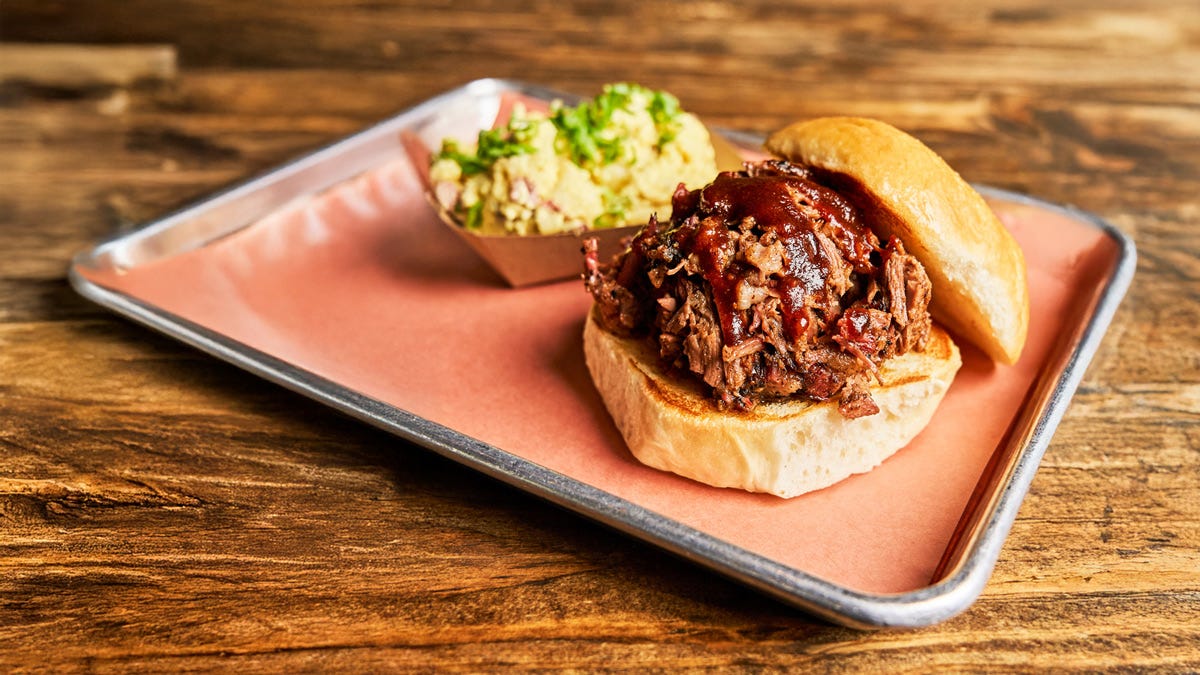
I do find the logistics of the offering curious. The brisket option will be available only to first class passengers on flights from Dallas Fort Worth International to LaGuardia and John F. Kennedy International airports in New York City, which is to say only on flights leaving Texas. I can see why the airline brass might think a bunch of New Yorkers would be gullible enough to consider warmed-over brisket an upgrade, but wouldn’t you want to offer it on the way to Texas and not on the return flight home after the passengers have presumably already eaten their fill of fresh, slow-smoked beef?
I would be remiss if I didn’t note that American is not the first airline to hop on the brisket bandwagon, as this post on the View from a Wing blog relates. Two years ago, British Airways offered a limited-time barbecue meal with bottles of Franklin Barbecue sauce and smoked brisket “inspired by” (read: not cooked by) Franklin.
What’s that faint white line you see way up in the sky somewhere between Dallas and New York City? That’s brisket cruising way over the shark at 30,000 feet . . .
The Coverage Was Swift
Former NFL All-Pro center Jason Kelce was spied on Wednesday hanging out with Chris Lilly at Big Bob Gibson Barbecue in Decatur, Alabama, and it certainly got the attention of the local media.
Most outlets, like WAFF48 TV and WHNT News 19 in Huntsville, merely gushed over the fact that “the future brother-in-law of Taylor Swift” had stopped off in two local restaurants. (The other was Brick Deli & Tavern, where he apparently enjoyed sandwiches and beer.) The perspicacious AL.com asked more probing questions—specifically, “What’s Jason Kelce doing at these Alabama restaurants?” Eagle-eyed reporter Matt Wake, noting that Kelce was wearing a Kingsford T-shirt and had a camera crew in tow, speculated that he might be filming a commercial.
Wake clearly isn’t a regular reader of the Robert F. Moss Newsletter. In my November 3rd Cue Sheet post, I reported that Kingsford Charcoal has engaged Kelce as a celebrity spokesperson, including using his name and likeness for “Slow Burn,” a burning charcoal-scented cologne. Chris Lilly, furthermore, is a long-time brand ambassador for Kingsford, traveling around the country to cook at tailgates and other football-related events. Its a pretty safe bet we’ll be seeing their two mugs in a bunch of online digital spots and TV ads in the near future.
It’s Not Just Me Saying It!
It’s one thing when some wiseacre from South Carolina keeps throwing shade on smoked brisket, but what if guys from New Jersey and Omaha are saying it, too? In the Quick Links section above I note the Smoke Sheet’s 6 BBQ Trends to Watch in 2026. Here’s Sean’s and Ryan’s #4 pick:
Brisket Falls Out of Favor
Brisket has been the undisputed king of BBQ meats in much of the country for more than a decade, but economics may finally dethrone it. With beef prices remaining outrageously high, pitmasters and consumers alike are looking for alternatives.
Might I recommend a thick, smoky pork steak instead?
Thanks for linking to us! Great write-up as always.
the way you tie history, labor, and modern trends together is what makes this newsletter such a standout. consistently excellent.