


Back in October I reviewed the state of America’s aspiring national barbecue chains in “A Big Barbecue Update, and in subsequent dispatches I touched upon the rise of multi-state “City ‘Cue” restaurants as well as the impact of the ever-rising price of beef on barbecue restaurants.
There’s been quite a bit news over the past few weeks related to these topics, so I thought I’d check back in on the state of the barbecue market, which, as I see it, is in a curious state of flux.
How Many Links in a Chain?
I chuckled when I saw this headline in the Savannah Morning News: “Georgia just got its first location of this beloved Carolina BBQ chain.” No, it’s not a Smithfield’s Chicken ‘N Bar-B-Q but rather the first Georgia location of Lewis Barbecue which, until the Atlanta output opened last Monday, had exactly two locations, one in Charleston and the other in Greenville.
A two-restaurant business is not exactly what I would call a chain. I’m not exactly sure how many locations are needed to qualify, but it’s certainly more than two.
A few years ago I actually had a bit of back and forth with my editor at Southern Living about how to define a barbecue chain. She initially proposed three locations as the benchmark. I countered, as I often do, by overthinking the matter:
There is such a difference between, say, a Rodney Scott’s BBQ or a SAWs and a big corporate chain like Sonny’s or Jim N Nicks. I find myself wondering whether we should split it into two chain categories — large chains and small/emerging chains. We could play with the criteria a little, but I would propose:
Large: More than 10 locations, especially if in multiple states
Small/Emerging: 4 to 10 locations - I would say 4 not 3 as the lower bound
This definition was much too confusing and unwieldy. I think we landed on four or more locations as our final line of demarcation, so Lewis Barbecue will not qualify until it opens its planned fourth location in Raleigh sometime next year.
Apparently newspapers in Georgia don’t agree, for the Athens Banner-Herald echoed the Savannah Morning News in its coverage of the new Lewis Barbecue. The headline read, “This South Carolina barbecue chain is opening its first GA restaurant.”
Then I noticed that the Banner-Herald story is bylined, “Miguel Legolas, Athens Banner-Herald,” and the name sounded vaguely familiar. I went back and checked the Savannah article. It’s bylined, “Miguel Legolas, Savannah Morning News.” No, Legolas isn’t working a day job in Savannah and moonlighting at the Athens paper. Click the link in his bio and you will learn that Legolas is actually part of “the USA Today Network’s Deep South Connect Team writing trending Georgia news, specializing in movies and other entertainment.”
In other words, he works for the sprawling Gannett empire, which operates several hundred newspapers across the U.S. and in November rebranded itself as USA Today Co., Inc. I guess they know a chain when they see one.
Dickey’s Drama Redux
One barbecue business that is definitely a chain is Dickey’s Barbecue Pit. In fact, it is the country’s largest barbecue chain, though exactly how big is a matter of some debate.
Last week reporter Aneurin Canham-Clyne of Restaurant Dive dove deep into Dickey’s discount policies, which are sowing even further dissent among the company’s already-cranky franchisees. Canham-Clyne interviewed multiple franchise operators who claim the corporate office’s liberal use of free sandwich cards, loyalty perks, and deep discounts are killing their margins.
Franchisees told Restaurant Dive that Dickey’s encouraged them to hand out 50 “Be My Guest” free sandwiches cards every day for the first three months of 2025, reimbursing them only for the base food and packaging costs of the freebies. Others griped about recent buy one-get-one-free combo meal deals, discounts on orders placed through Dickey’s digital platform and third-party delivery apps, and an overly generous loyalty card program. One anonymous operator showed Restaurant Dive the receipt for a $170 order for which a customer used loyalty points and paid nothing.
For its part, Dickey’s disputed the numbers given by the anonymous franchisees, claiming that only a fraction of a percent of orders are part of a loyalty deal and only 3% of digital orders have a discount applied, in contrast to the “almost half” figure claimed by one interviewee.
Perhaps more interesting are the conflicting numbers cited regarding the chain’s growth—or lack thereof. The Restaurant Dive report notes that a net of 83 franchised Dickey’s restaurants closed last year, pulling the overall unit count down to 385 at the end of 2024. The reporter counted the U.S. restaurants listed on Dickey’s website and found just 318 open units in June of this year and slightly fewer, 314, here in December.
In its most recent press release, however, the company touted the opening of a new Dickey’s in New Airdrie, Alberta, as “part of its rapidly growing Canadian expansion” and painted a picture of vigorous growth:
With 387 locations in the U.S. and several countries, Dickey’s Barbecue Franchise and Dickey’s Restaurant Brands continue to grow under the leadership of Roland Dickey Jr., CEO of Dickey’s Capital Group, and Laura Rea Dickey, CEO of Dickey’s Barbecue Restaurants, Inc.
I conducted a count of my own on the Dickey’s store locator page and also came up with 314 restaurants. Throw in the 24 Canadian outlets and 7 other international locations and you have a total of 345 Dickey’s-branded locations.
I will assume that the company is including in its 387 number some non-Dickey’s restaurants that serve its virtual brands like Wing Boss and Big Bob’s Bakers, especially since Dickey’s touted in October that it had just opened 28 new “ghost kitchens.” I should note that the October press release stated that Dickey’s had “more than 400 locations worldwide and counting.”
2026 will reveal whether the company has indeed turned the corner and mapped out “a creative pathway to long term expansion.” In any event, it will likely remain America’s largest barbecue chain for some time. Its nearest competitor, Maryland-based Mission BBQ, by my latest tally has 153 locations.
Comings and Goings
I recently made a barbecue tour down the Florida coast all the way to Miami, where I checked out a bevy of recently-opened joints like the Drinking Pig in Coconut Grove and Apocalypse Barbecue in Kendall. They’re practitioners of a new mode of “Miami Style BBQ” that blends Texas-inspired brisket, ribs, and sausage with the flavors of the Caribbean. (I have a Southern Living story in the works on that subject, but you can check out my Instagram feed for some of the highlights.)
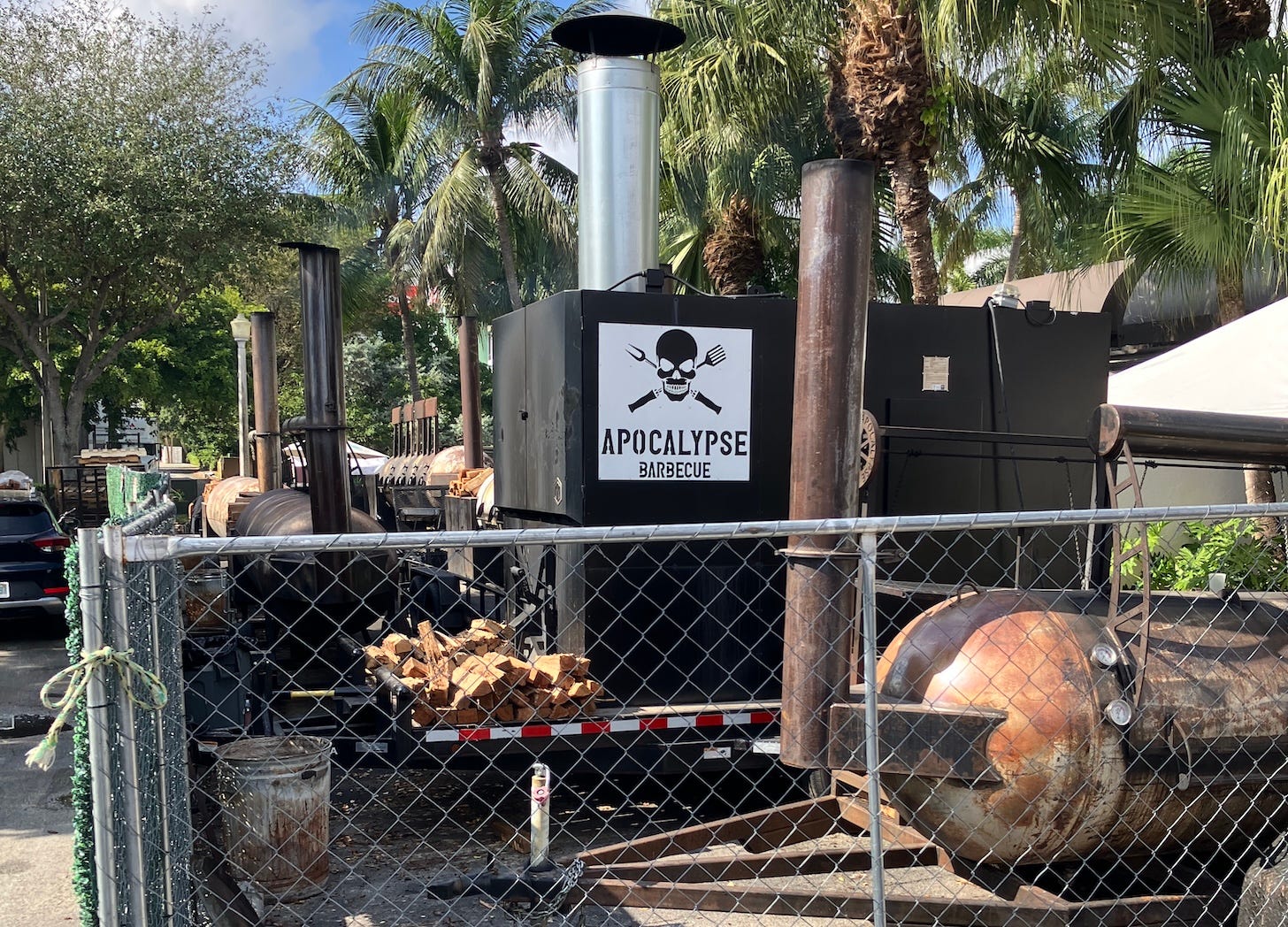
The Florida barbecue scene is indeed changing. In recent Cue Sheet dispatches I reported that the three locations of Jacksonville’s Jenkins Quality Barbecue have closed and that the owners of the 75-year-old South Dixie Highway location of Shorty’s Bar-B-Q have sold the property, so the restaurant is slated for demolition sometime in 2026.
Word came while I was on the road that another Old Florida establishment—36-year-old Tom Jenkins’ Bar-B-Q in Fort Lauderdale—will be closing December 21st. I also discovered while in South Florida that Uncle Tom’s Barbecue in Miami, which had been in business since 1948, has quietly closed its doors, too. (As far as I am aware, there was no relationship among the Jacksonville Jenkins family, Tom Jenkins in Fort Lauderdale, and Miami’s Uncle Tom.)
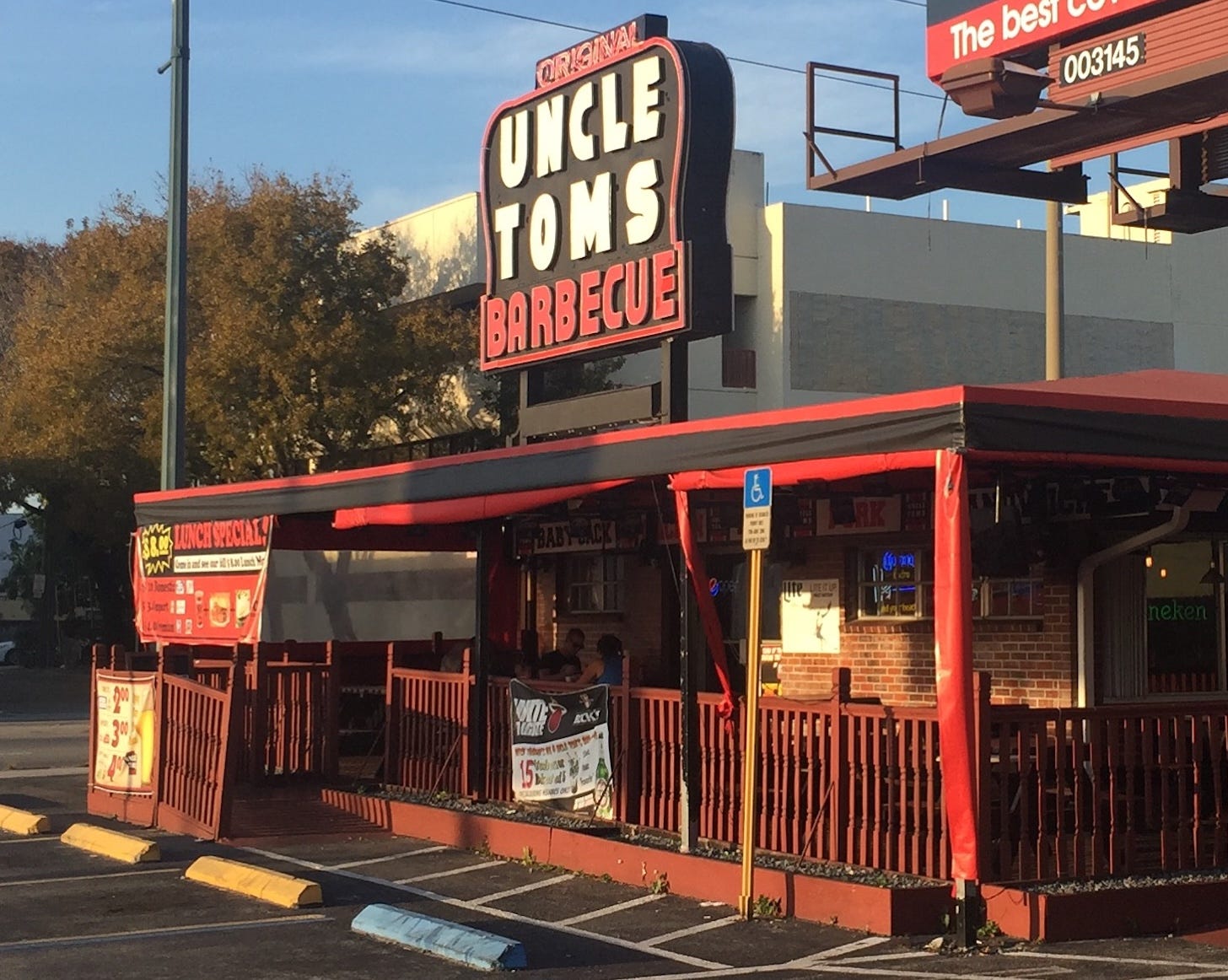
I would be tempted to connect the dots and call it a changing of the guard, with the older mom ‘n pop style giving way to the newer craft mode. Other recently announced closures, though, show the newer craft world is starting to experience turnover, too.
I noted in last week’s dispatch that Killen’s Barbecue in Houston was closing its Woodlands location. The past week brought news that the well-regarded Brett’s BBQ Shop in Katy, Texas, will be closing on December 28th after seven years in business. Up in New York City, Fette Sau, one of the early entrants in Brooklyn’s now-thriving craft barbecue scene, announced it is closing on December 21st after 18 years.
A common and somewhat troubling theme among these announcements is not just rising expenses but also declining demand. Brett’s owners cited a decrease in foot traffic over the past year alongside rising food and labor costs. Fette Sau’s Owner Joe Carroll told New York magazine’s Grub Street that his restaurant was the victim of “changing tastes.” Though his rent has steadily risen (from $4,200 when he opened in 2006 to an eye-popping $16,500 per month today), sales started declining after the pandemic years and really dropped off this fall. “Honestly, the business just wasn’t there,” he told Grub Street.
Speaking of declining traffic, a detail in the Grub Street story made me wonder when the reporter last visited Fette Sau:
Texas transplants may have grumbled about the prices—$22 per pound for some of the ‘cue—but neighbors and food writers loved the place.
A Texas transplant today would be thrilled to find brisket so cheap (see “The Price of Beef is (Still) Too Damn High”.) As of today, Fette Sau is selling its brisket for $35 per pound (technically, $17.50 per half pound,) and at $24 a pound the smoked chicken wings are the cheapest meat on the menu.
It’s too soon to tell whether high menu prices are starting to dampen demand and whether the closing of Brett’s and Fette Sau are just outliers or part of a larger trend. It’s certainly something to keep an eye on as we get out into 2026.
Quick Bites
Floyd “Sonny” Tillman, the founder of the Sonny’s BBQ chain, passed away on December 7th at the age of 96. He founded the first Sonny’s restaurant in Gainesville, Florida, in 1968 and grew it into what is now the 4th largest barbecue chain in the country, with around 90 locations in eight Southern states.
After three years at Aggie Park in the heart of the Texas A&M campus, the organizers of the Troubadour Festival have announced that for the 2026 outing it will be moving to nearby Midtown Park in Bryan. The new venue will accommodate more attendees and also let the festival be held earlier in the year—March 28th—instead of in May, which will mean cooler weather—a non-trivial consideration for a Texas barbecue festival.
Burnt Ends
This Burnt End Post Left Them Howling with Laughter, and For Good Reason
“This BBQ recipe went Viral and for Good Reason,” declares the title of a newly-posted video on YouTube. In the intro, the host exclaims, “This is the new barbecue trend for the holiday season for 2025.”
The trend, of course, is pulled ham, which you may have been hearing a lot about lately if you watch barbecuing videos online. Now why, you might ask, did this particular pulled ham video go viral? Could it be because . . .
It’s sponsored by a grill manufacturer (Kamado Joe)
The host/cook has a mysterious identity (“Pitmaster X”)
The host/cook has a decidedly European accent, which isn’t the norm in barbecue videos
The host/cook said it went viral, so it did
It turns out that Pitmaster X is Roel Westra, a self-described “renowned barbecue enthusiast,” and that accent is Dutch. Good old fashioned bone-in city ham, Westra asserts, is now overtaking brisket, rib roast, and turkey as a leading barbecue cut, especially when it’s smoked on a barbecue pit and pulled to shreds by hand.
But let’s talk about the “viral” part. When I first came across the video, about 24 hours after it posted, it had 29,137 views and already bore the “This BBQ recipe went Viral” title, which I assume it had from the start. As of this writing, three days later, the number has risen to 75,265.
That’s pretty good, but like the definition of a chain restaurant, how many views qualify a social media post as “viral” is open to debate, and the number varies from platform to platform. Here’s how web hosting platform Bluehost quantifies it:

Those 5 million views, Bluehost adds, generally need to be achieved within a week, so Pitmaster X does have a few more days to pull it off. I’m sure this newsletter mention will help put him over the top.
If you look at the comments on the Pitmaster X video, you’ll see the first one notes, “Meat Church BBQ uploaded almost the same thing yesterday.” Indeed, Meat Church’s pulled ham video, which is titled “The Holiday Meal Nobody Sees Coming,” now has over 133,000 views. An influencer with the handle @marriedtobbq, we should also note, posted a pulled ham video to YouTube shorts last year that now has over 639,000 views.
Maybe Pitmaster X was actually correct in stating, “This BBQ recipe went viral.” It just went viral for other people.
The top comment on Married to BBQ’s video, incidentally, is from a user calling himself Buford_T_Justice1, who quips, “I had a pulled ham once and my coach told me to walk it off.”
Couldn’t have said it better myself.

Great newsletter, Robert. Best one yet. For some reason seven sticks out to me as the magic number that retail outlets have to be - to be called a chain. Probably stuck with me from a high school business class. I'm lucky that I own my business property. I hear from other business owners in strip centers and retail centers that their rents are increasing at astronomical rates. Some as high as $42/foot - with $35/foot being the new standard. That's $8750 to $10,500 per month. Plus parking lot and maintenance fees. Folks like me and Couch's BBQ are lucky to have what we have. Merry Christmas to you and your family. We'll get together sometime in the first qtr. of 2026.